

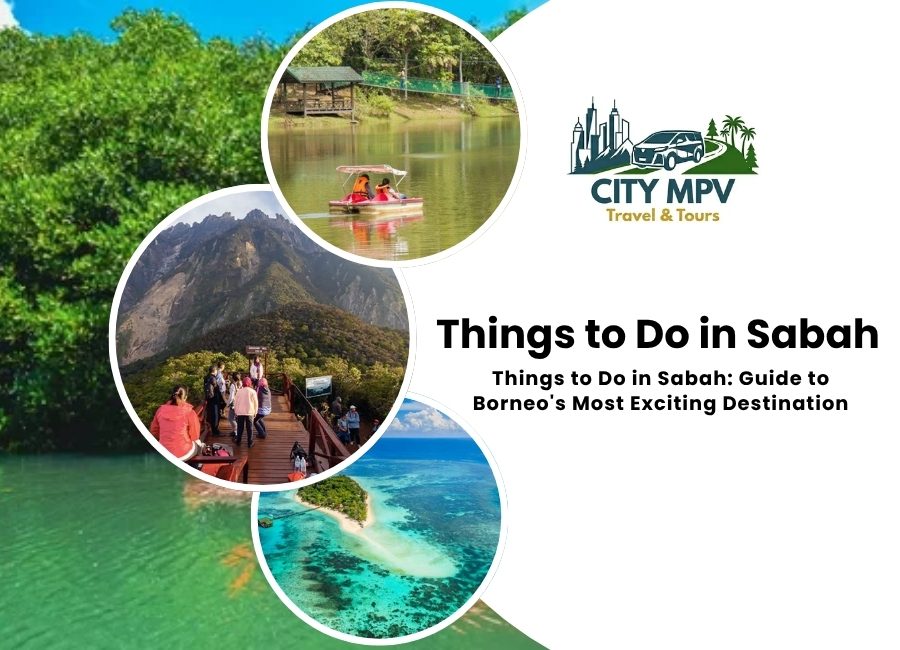
Sabah sits on the northeastern tip of Borneo, one of the largest islands on earth, and it holds a kind of wild, layered beauty that very few places in Southeast Asia can match. This Malaysian state is not your typical beach holiday. It is a destination where ancient rainforests meet turquoise coastlines, where the world’s highest mountain outside the Himalayas watches over fishing villages, and where you can be snorkeling above a coral reef in the morning and watching wild orangutans in the canopy by afternoon.
If you are planning a Sabah tour and wondering what to fill your days with, the honest answer is that the hardest part will be choosing what to leave out.
Climb Mount Kinabalu, the Roof of Borneo
Standing at 4,095 metres, Mount Kinabalu is the tallest peak in Malaysia and the highest mountain between the Himalayas and Papua New Guinea. It is the single most iconic experience Sabah has to offer, and for good reason.
The standard two-day summit climb begins at Timpohon Gate and takes trekkers through montane forest, sub-alpine scrubland, and eventually bare granite slopes that feel like another planet. Most climbers spend the night at Laban Rata Resthouse before pushing to the summit at Low’s Peak before sunrise. On a clear morning, the view extends across Sabah, out to the islands in the South China Sea, and all the way into Indonesian Borneo.
Kinabalu Park itself is a UNESCO World Heritage Site and one of the most biodiverse places on the planet. Even without attempting the summit, a walk through the park’s botanical trails reveals pitcher plants, wild orchids, and tree ferns that exist nowhere else on earth. The Poring Hot Springs, located on the park’s lower elevation edge, are a favourite stop for soaking tired legs after the climb.
Permits for the summit are limited and book out months in advance during peak season, so early planning is essential for any Sabah travel itinerary that includes this activity.
Dive Sipadan Island, One of the World’s Top Dive Sites
Sipadan Island is in a category of its own. Located in the Celebes Sea off Sabah’s southeast coast near Semporna, it is Malaysia’s only true oceanic island, rising from a depth of 600 metres below the surface. Marine biologist Jacques Cousteau famously described it as an untouched work of art, and decades later, that reputation holds firm.
Diving Sipadan means swimming through massive schools of bumphead parrotfish, coming face to face with green and hawksbill sea turtles on almost every dive, and drifting past walls draped in barrel sponges and sea fans. Sharks are a constant presence, including whitetip and grey reef sharks patrolling the deeper sections of the reef. Barracuda Point, Turtle Cavern, and Hanging Gardens are among the named sites that divers travel specifically to experience.
The Malaysian government strictly controls the number of dive permits issued per day to protect the reef. Booking a dive package well in advance through a licensed operator in Semporna is the only way to guarantee access. Mabul Island, just a short boat ride from Sipadan, serves as the main base for divers and also offers excellent macro diving and muck diving in its own right.
For non-divers or beginners, snorkeling around Mabul and the surrounding islands still delivers encounters with reef fish, sea turtles, and colourful corals that would be the highlight of almost any other tropical destination.
Explore Tunku Abdul Rahman Marine Park
Kota Kinabalu’s most accessible nature escape sits just 15 minutes by boat from the city’s Jesselton Point ferry terminal. Tunku Abdul Rahman Marine Park is a cluster of five islands, Gaya, Manukan, Sapi, Mamutik, and Sulug, all protected within a single national park boundary.
Manukan and Sapi are the most visited, with calm, shallow waters ideal for snorkeling and swimming. The coral gardens around both islands support moray eels, parrotfish, clownfish, and reef sharks that have grown comfortable around regular visitors. Gaya Island is the largest and the most forested, with jungle trails cutting through the interior and a resort perched above the treeline.
The park also hosts the Coral Flyer Zipline, which stretches 250 metres across the open sea from Gaya Island to Sapi, offering a perspective of the archipelago that no boat can match. Kota Kinabalu Island hopping works equally well as a half-day trip or a full day of swimming, eating fresh seafood, and watching the Kota Kinabalu skyline shimmer in the distance.
Watch Wild Orangutans at Sepilok Rehabilitation Centre
The Sepilok Orangutan Rehabilitation Centre near Sandakan on Sabah’s east coast is one of the most emotionally affecting wildlife experiences in all of Borneo. Established in 1964, the centre takes in orphaned and injured orangutans, primarily those displaced by logging and forest loss, and prepares them for life back in the wild.
Twice daily feeding sessions at Platform A bring semi-wild orangutans swinging through the jungle canopy to collect supplementary food while they continue their transition to full independence. These animals are not performing. They come and go as they choose, and watching a young orangutan figure out a rope or a mother carry her infant through the trees is something that stays with you long after the visit.
Adjacent to Sepilok is the Bornean Sun Bear Conservation Centre, the world’s only facility dedicated to the rehabilitation and care of sun bears, the smallest bear species in the world. Visiting both in a single morning is very manageable and makes for one of the most wildlife-rich mornings possible on any Sabah tour package.
Take a River Safari on the Kinabatangan
The Kinabatangan River winds 560 kilometres through the lowland rainforests of eastern Sabah, and along its muddy banks, some of the most spectacular wildlife in Southeast Asia gathers with remarkable regularity. This is where Sabah’s Borneo wildlife reputation was truly built.
Morning and evening boat cruises from lodges based in Sukau or Bilit are the standard way to explore the river. Proboscis monkeys, with their distinctive long noses and pot-bellied frames, are almost always visible in the riverside fig trees as dusk approaches. Rhinoceros hornbills fly low over the water. Long-tailed and pig-tailed macaques raid the trees near the bank. Estuarine crocodiles rest on exposed mud between the roots.
Borneo pygmy elephants, the smallest elephant subspecies in the world, appear seasonally along the Kinabatangan. Spotting a herd crossing a shallow stretch of the river is the kind of encounter that guides in Sukau still talk about for weeks. There are no guarantees with wildlife, but the Kinabatangan consistently delivers sightings dense enough to satisfy even experienced wildlife photographers.
Most visitors spend two to three nights at a river lodge, which allows for multiple boat cruises and an evening spotlighting session to look for sleeping birds and the occasional clouded leopard.
Discover Danum Valley Conservation Area
For those who want to experience Borneo’s rainforest without the crowds, Danum Valley is the answer. This protected area covers 438 square kilometres of primary lowland dipterocarp forest, and much of it has never been logged. Scientists estimate the forest is at least 130 million years old.
Walking the trails around the Borneo Rainforest Lodge or the Danum Valley Field Centre puts you inside one of the most biodiverse ecosystems on the planet. At night, the soundscape alone is extraordinary. Guided night walks reveal forest frogs, stick insects, tarantulas, and flying squirrels gliding between the trees in the torchlight.
Danum Valley is also one of the best places in Sabah to see the Bornean gibbon and to find rare bird species, including the Bornean bristlehead. The remoteness is part of the appeal. There are no towns here, no tourist shops, no noise except the forest itself.
Experience Mari Mari Cultural Village
Just a short drive from Kota Kinabalu, Mari-Mari Cultural Village offers an immersive look at the living traditions of five Sabahan ethnic groups: the Kadazan-Dusun, Bajau, Murut, Lundayeh, and Rungus. This is not a museum. It is a working cultural space where guides from each community demonstrate traditional practices in reconstructed longhouses built using original materials and methods.
Visitors walk between the houses, watching fire-making techniques, blowpipe demonstrations, rice wine brewing, and traditional tattoo art. The food tasting is a genuine highlight, with bamboo chicken, fermented rice, and other dishes served the way they have been for generations. A cultural performance at the end ties everything together with music and dance specific to each group.
The Kadazan-Dusun harvest festival, Kaamatan, celebrated every May, is one of the best times for the Mari Mari cultural village tour if you want to experience this cultural dimension at its most vibrant.
Try White Water Rafting on the Padas River
The Padas River, which cuts through the deep gorge between Beaufort and Tenom in Sabah’s interior, provides some of the most thrilling white water rafting in Kota Kinabalu. The rapids are classified between Grade III and Grade IV, which means genuine adrenaline without requiring prior experience.
The journey to the river is half the adventure. Participants board a classic jungle train from Beaufort Station, watching the interior unfold through the windows before reaching the put-in point at Pangi. The rafting itself passes through dense jungle where monkeys watch from the bank, and kingfishers dart through the spray.
This is a full-day activity that works well from Kota Kinabalu, typically operated as an organised Sabah tour package that handles all logistics, including the train transfer, equipment, and meals.
Island Hop and Snorkel Around Mantanani Island
Further up Sabah’s northwest coast, Mantanani Island sits far enough from the mainland to feel genuinely remote. The three-island group is known for extremely clear waters, healthy reef systems, and a relaxed pace that feels different from the more visited islands near Kota Kinabalu.
Mantanani is one of the few historic places in Sabah where dugong sightings are occasionally reported, and the macro diving here attracts underwater photographers looking for seahorses, ghost pipefish, and rare nudibranchs. For surface visitors, the snorkeling is excellent, and the beaches are quiet enough to feel like you have them to yourself outside of peak season.
Visit the Floating Mosque and Explore Kota Kinabalu City
Kota Kinabalu is far more than a transit hub for Sabah adventures. The city itself rewards a full day of exploration and is best experienced with someone who knows its rhythms.
The Sabah City Mosque, Masjid Bandaraya, is built on a man-made lagoon and is widely regarded as one of the most beautiful mosques in Malaysia. Its reflection in the surrounding water creates a photograph that appears all over travel media but still impresses in person. The Puh Toh Tze Buddhist Temple on Tuaran Road, with its large courtyard and traditional architecture, offers a quieter moment of contemplation.
The Filipino Market and the Central Market are where Kota Kinabalu’s daily food culture comes alive. Dried seafood, tropical fruits, and Sabahan snacks line the stalls. In the evening, the hawker stalls along the waterfront serve some of the freshest grilled fish and seafood in the country.
The Signal Hill Observatory Platform, a short climb above the city centre, gives panoramic views over Likas Bay and, on a clear morning, reveals Mount Kinabalu standing watch in the distance. Padang Merdeka, Australia Lane, and the Sabah Foundation Tower are all worth a stop on a city tour route.
Watch the Klias Fireflies and Proboscis Monkey Cruise
An evening river cruise through the Klias Wetlands, about 90 minutes south of Kota Kinabalu, is one of Sabah’s most quietly magical experiences. As the sun sets over the nipa palms, proboscis monkeys gather in the trees to settle for the night, giving visitors one of the most reliable sightings of this endemic species anywhere in Borneo.
After dark, the fireflies emerge along the riverbank mangroves and begin their synchronised light display. Hundreds of them pulse in unison across the tree canopy, creating an effect that looks more like a starfield than an insect display. The proboscis monkey and fireflies tour is genuinely spectacular and completely unlike anything most visitors have seen before.
Best Time to Visit Sabah
Sabah is a year-round destination, but the drier months between May and September are generally considered the best time to visit for outdoor activities. Sipadan diving is at its clearest between April and September. Mount Kinabalu summit views are most reliable during the same period. The Kinabatangan wildlife sightings are strongest when river levels drop between July and September, concentrating animals near the water’s edge.
The northwest monsoon season from October to March brings heavier rain to some parts of Sabah, though the east coast and interior often remain manageable. Regata Lepa in April and the Kaamatan harvest festival in May are two cultural events worth timing a trip around if possible.
Plan Your Sabah Tour with City MPV Travel and Tours
Sabah is a destination that rewards good planning and local expertise, and that is where City MPV Travel and Tours becomes genuinely valuable. Based in Kota Kinabalu,City MPV is a licensed Sabah tour operator that runs its programs directly, handling everything from transport and guides to jetty operations and on-ground logistics.
City MPV offers a range of tours that cover the best of what Sabah has to offer. Their Kota Kinabalu City Tour takes guests through the Floating Mosque, Anjung Kinabalu Market, Australia Lane, and Padang Merdeka, with a complimentary local lunch included. Their Bongawan River Cruise, one of the more distinctive offerings in Sabah, combines a visit to the Floating Mosque and a local chocolate factory at Cocoa Kingdom before heading to the tranquil Bongawan River to spot proboscis monkeys and macaques in their natural habitat. They also cover Mount Kinabalu, island hopping, and other signature Sabah sightseeing tours as part of their packages.