

There are landmarks you visit and landmarks that stay with you. The Kota Kinabalu City Mosque falls into the second category.
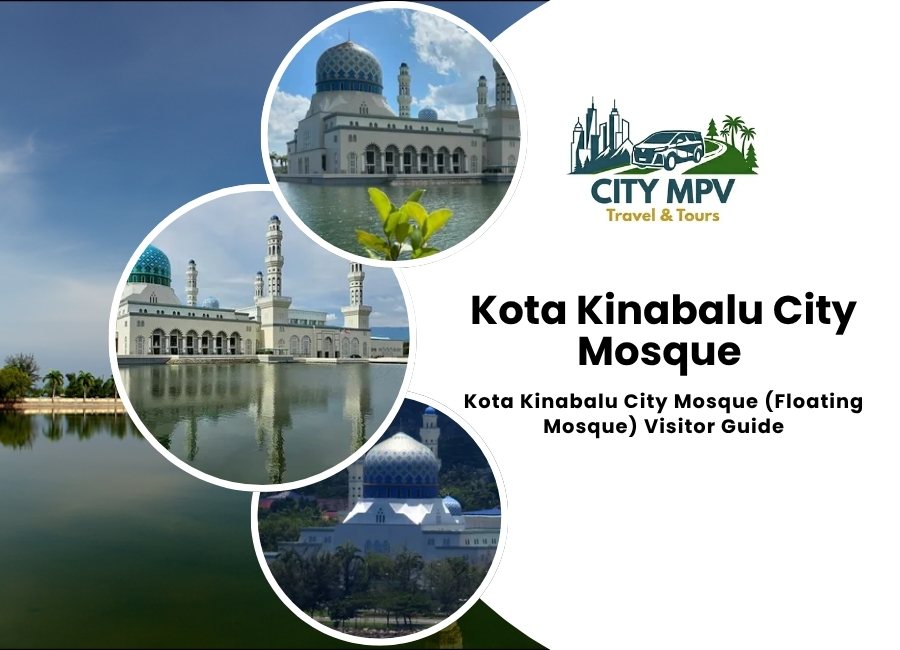
Known widely as the Floating Mosque, this iconic structure sits on the banks of Likas Bay, where its reflection in the surrounding lagoon creates the impression that it hovers between the water and the sky. It is one of the best places to visit in Kota Kinabalu, and once you see it at the right moment, it is easy to understand why.
This guide covers everything you need to know before visiting, from architecture and history to practical details like opening hours, dress code, and the best times to go.
What Is the Kota Kinabalu City Mosque?
Officially named Masjid Bandaraya Kota Kinabalu, this mosque is a prominent religious and architectural landmark located in the capital city of Sabah, Malaysia. It is the largest mosque in Kota Kinabalu and one of the most significant in the entire state.
Construction began in 1992, and the mosque was formally opened in 2000. It is located roughly 5 km north of the city centre, in an area between the shoreline and Likas village, on land reclaimed from the sea.
The building is often called the Likas Floating Mosque by locals, a name that reflects both its location near Likas Bay and the visual effect created by the man-made lagoon surrounding it.
The Architecture: Inspired by Medina
The design of the mosque is one of its most compelling features.
Built in a modern Islamic architectural style, the mosque drew its inspiration from the Nabawi Mosque in Medina, Saudi Arabia — one of the holiest sites in the Islamic world.
Its most prominent feature is the blue and gold dome that catches the light at any hour, complemented by graceful minarets that rise against the open sky. The overall design blends traditional Islamic aesthetics with contemporary construction, giving the building a timeless quality that feels both reverent and welcoming.
The mosque is built on a site of approximately 2.47 acres at Likas Bay, and its prayer hall is large enough to accommodate between 9,000 and 12,000 worshippers at a time.
Inside, intricate Islamic calligraphy and geometric patterns line the walls, and the scale of the interior reflects the mosque’s importance as a community gathering point for Sabah’s Muslim population.
Beyond the prayer hall, the compound also includes three madrasahs, a palliative care clinic, and a fish farm, making it a functioning community institution, not just a tourist attraction.
The Floating Effect: How It Works
The famous floating illusion is not a trick of the eye; it is an architectural choice.
From a distance, the mosque appears to rest on top of the water, an effect created by the man-made lagoon built around the structure, whose calm surface mirrors the building above it.
The strength of this reflection changes throughout the day and depends on tide levels. The best time to capture it is at sunrise or sunset, when the water is calmest, and the light transforms the mosque into something almost unreal. On a still morning, the gold dome and four minarets appear twice, once in the sky and once in the water below.
On a full moon night, the effect is different again. The white structure and its reflection glow under natural light in a way that photographs rarely do justice.
Visiting Hours and Entrance Fee
The mosque is open to visitors Monday through Sunday from 8:00 AM to 12:00 noon, 2:00 PM to 3:30 PM, and 4:00 PM to 5:00 PM. It is closed to non-Muslim visitors on Fridays. These hours are subject to change around religious events and prayer schedules, so it is worth checking ahead if you are planning your visit around a specific time.
The entrance fee is RM 5 for foreign visitors. If you need to borrow attire, there is an additional charge of approximately RM 10.
Upon arrival, visitors are asked to register with the Kota Kinabalu City Mosque Tourism Management before entering the compound.
Dress Code and Visitor Guidelines
Respecting the dress code is not optional; it is a genuine requirement, and the mosque takes it seriously.
Women are required to cover their arms from shoulder to wrist, in addition to covering their legs. Both men and women should arrive in modest clothing that covers the body appropriately.
If your clothing does not meet the guidelines, robes and headscarves are available to borrow at the entrance. This service makes the mosque accessible to all visitors, regardless of how they arrive dressed.
Food and drinks are not permitted inside the mosque area. When taking photos or videos, visitors must be mindful not to pose or act disrespectfully, and imitating religious acts of prayer is strictly not allowed.
These rules exist to protect the sanctity of an active place of worship. Visitors who approach the mosque with respect almost universally describe it as one of the most peaceful and memorable stops in Kota Kinabalu.
Photography Tips
For photographers, this is one of the most rewarding spots in all of Borneo.
The best time to visit for photography is in the early morning or during golden hour, when the lagoon is calm and the light creates a magical reflection
A wide-angle lens works well for capturing the full scale of the mosque and the surrounding water. A polarizing filter can help enhance the contrast between the sky and the lagoon surface. Midday lighting tends to be harsh, which flattens the reflection and makes the golden dome look washed out
Photography inside the prayer hall may be restricted. Outside, in the lagoon grounds and along the wooden walkway, there are countless angles worth exploring. The view from the far end of the pathway is the classic shot most visitors go home with.
How to Get to the Kota Kinabalu City Mosque
The mosque is located along Jalan Pasir in Teluk Likas, about 5 km from the Kota Kinabalu city centre.
The most straightforward way to get there is by Grab, which takes roughly 15 minutes from most hotels in the city and costs around RM 10 to 20. Bus No. 5A, which runs toward UMS (Universiti Malaysia Sabah), also passes through Likas and is a more budget-friendly option for independent travellers. Ask the driver to drop you off after the Tanjung Lipat roundabout.
If you are joining a city tour, the mosque is a standard stop on most guided half-day itineraries in Kota Kinabalu.
Cultural and Religious Significance
Islam is the official religion of Malaysia, and the Kota Kinabalu City tours, including Mosque plays a vital role not only in daily worship but in community life, hosting gatherings during Hari Raya Aidilfitri and serving as a social and spiritual anchor for the city’s Muslim community.
For visitors of any background, the mosque offers something genuine: a chance to witness how faith, architecture, and daily life intersect in Sabah. It is not a museum piece. It is a living institution, and the experience of visiting feels richer for it.
What to Do Nearby
The mosque pairs naturally with other landmarks in the area.
After your visit, the Sabah Foundation Tower (Menara Tun Mustapha) is a short drive away, a striking cylindrical structure that stands as one of Sabah’s most distinctive buildings. Signal Hill Observatory, Padang Merdeka, and the waterfront markets around Jesselton Point are all within easy reach if you are spending a full day exploring the city.
For travellers who want to go beyond the city, the beaches and islands of Tunku Abdul Rahman Marine Park are visible from Kota Kinabalu’s coastline and accessible within a short boat ride.
Plan Your Kota Kinabalu Visit with City MPV Travel & Tours
The Kota Kinabalu City Mosque is already a highlight of the Bongawan River Cruise & City Tour offered by City MPV Travel & Tours, a locally based operator with deep knowledge of Sabah’s landmarks and cultural sites. Their city tour takes you to the mosque, Anjung Kinabalu Market, Australia Lane, Padang Merdeka, and the Sabah Foundation Tower, all in a single half-day, with hotel transfers and a local lunch included.
For travellers who want to see more of Sabah, City MPV also offers island-hopping, river cruises, and wildlife experiences across Borneo. You can explore the full range of tours at citympvtravel.com.