

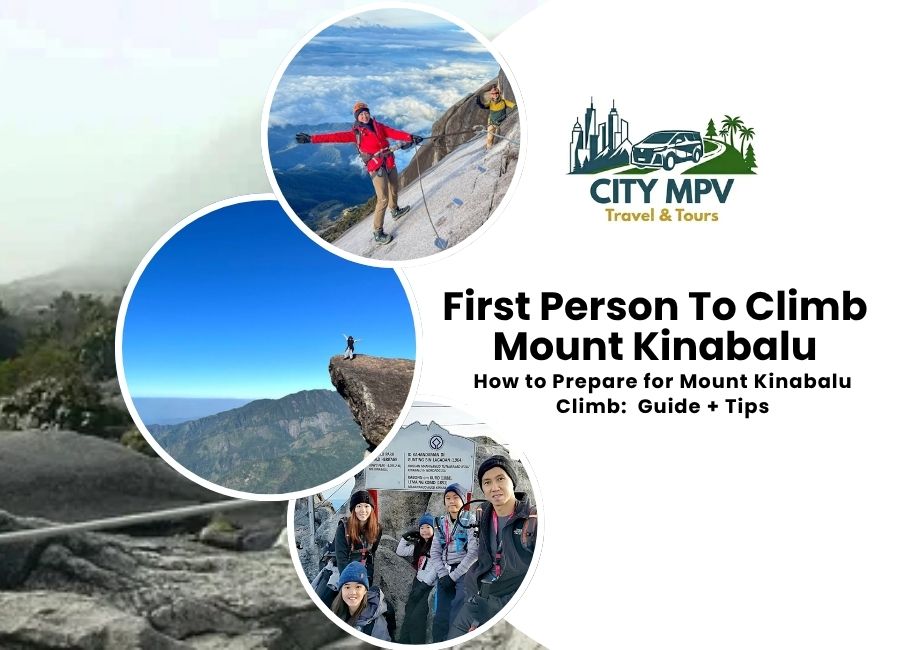
Every climber who reaches the summit of Mount Kinabalu today is retracing a path that only became known to the outside world less than two centuries ago. The mountain itself is far older than that, and to the Kadazan-Dusun people who have lived in its shadow for generations, it was never really unclimbed. But when travelers ask who was the first person to climb Mount Kinabalu, the answer usually points to one name in the colonial record books, and the real story is a little more layered than a single date.
Hugh Low and the 1851 ascent
The first documented climb of Mount Kinabalu is credited to Hugh Low, a British colonial administrator based on the nearby island of Labuan. He made his historic ascent in March 1851, and today both the mountain’s highest peak and a deep gully on its northern face carry his name.
Stop scrolling and start traveling! City MPV Travel and Tours makes it easy to turn this into your next unforgettable trip. Seats fill fast, so grab yours today.
Book Your TourLow was not a mountaineer by training. He was better known as a colonial administrator whose working style later became something of a template for other British officials across Southeast Asia. He also had a strong interest in botany, which partly explains why a mountain nobody from outside Borneo had properly explored caught his attention in the first place.
His first climb took place in March 1851, and he returned twice more in 1858 alongside Spenser St. John, the Consul General of Brunei at the time. On that original 1851 expedition, he did not travel alone. Local guides and porters accompanied him, and by some accounts the full party numbered over forty people, taking around nine days to reach the summit plateau.
Why Hugh Low never reached the true summit
This is the detail that surprises a lot of people. Low reached the summit plateau, the wide rocky shelf near the top of the mountain, but he never actually stood on the true highest point. Looking up at the final rocky spire, he judged it beyond human reach, believing it was accessible only to creatures that could fly.
He came back in 1858 hoping to finish what he started, but conditions worked against him again. Swollen feet from the climb slowed him considerably, and he fell short of the true peak a second time, even as his companion St. John pushed a little further up.
Because of this, Low’s name is permanently attached to the mountain without him ever technically completing the full ascent. Low’s Peak, the actual highest point of Mount Kinabalu today, and Low’s Gully, the dramatic ravine cutting into the north face, both honor that first attempt rather than a finished summit. These landmarks are also important parts of the Mount Kinabalu Climbing Routes, which continue to attract climbers exploring the mountain’s historic and scenic trails.
The people who were there before written history
It’s worth pausing on something that often gets left out of the story. The Kadazan-Dusun communities living around the mountain had their own long relationship with it well before Low ever arrived. Local tradition holds that the mountain’s name comes from the words Aki Nabalu, meaning the revered place of the dead, and an annual ceremony involving prayers and offerings is still carried out at the summit to this day.
That reverence is also part of why no earlier ascent by local people was ever written down anywhere. For centuries, the Dusun people generally kept their distance from the upper slopes, treating the mountain as a resting place for departed spirits rather than a peak to be conquered for its own sake. So while Hugh Low’s 1851 expedition is the first recorded climb in the Western sense, it isn’t necessarily the first time human feet ever touched those slopes. It’s simply the first version anyone wrote down and published.
John Whitehead and the true first summit
The person who actually completed what Low started was a different Englishman altogether. John Whitehead, an explorer and natural history collector working across Southeast Asia at the time, is recognized as the first person to document reaching the actual summit of Mount Kinabalu. He achieved this in 1888, after several annual attempts stretching back to 1885.
Whitehead’s background was in collecting birds and other specimens rather than mountaineering, but persistence across repeated failed attempts eventually got him to the top of the spire that Low had once dismissed as unreachable. So if the question is specifically about who first stood on Mount Kinabalu’s highest point, rather than who first documented reaching the summit plateau below it, 1888 and John Whitehead is the real answer.
A mountain that took decades to fully understand
Between Low’s cautious retreat in 1851 and Whitehead’s eventual success in 1888, close to four decades passed. That gap says a lot about how difficult and unfamiliar this terrain was to outsiders at the time, even though the mountain sits at a height modern climbers now cover in two days with the right preparation.
The mountain has changed enormously since then. What was once a multi-day expedition involving dozens of porters and no real trail system is now a well marked route through Kinabalu Park, complete with rest huts, guide ropes, and clear checkpoints along the way. Even so, the origin story still shapes how the mountain is talked about today, from the naming of Low’s Peak to the ongoing respect shown toward Kadazan-Dusun beliefs about what lies at the summit.
Stop scrolling and start traveling! City MPV Travel and Tours makes it easy to turn this into your next unforgettable trip. Seats fill fast, so grab yours today.
Book Your TourFor travelers planning their own ascent, the logistics side has also gotten far simpler than what Low’s forty person expedition had to deal with. City MPV Travel and Tours arranges Mount Kinabalu climbing packages from Kota Kinabalu, taking care of park permits, a licensed guide, and transport, so the planning doesn’t fall entirely on the climber the way it once did back in the 1850s.