

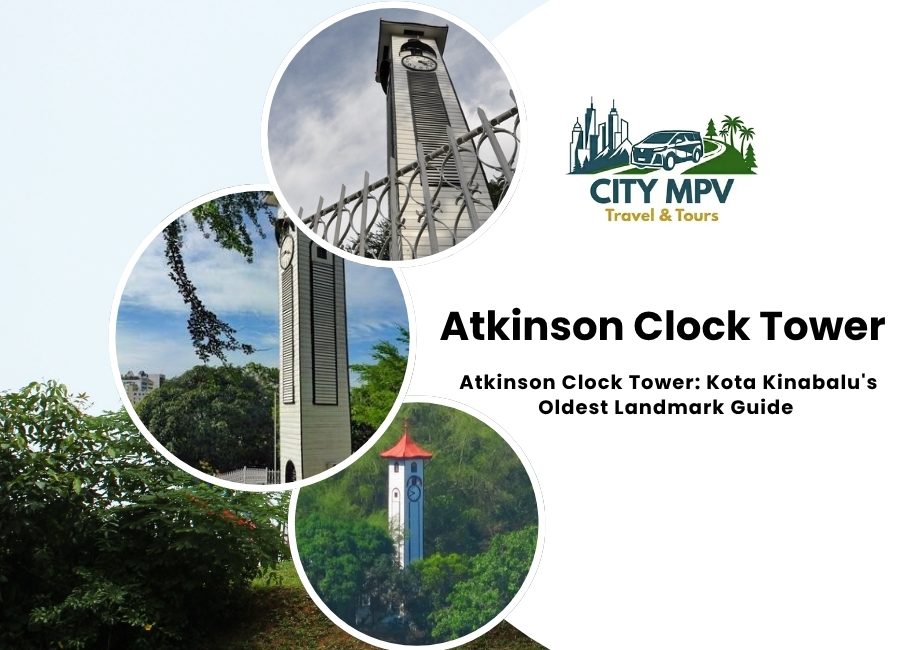
When travelers picture Kota Kinabalu, they often think of islands, coral reefs, and the distant outline of Mount Kinabalu. But sitting quietly on a low hill just minutes from the city waterfront is something older and quieter than any of that. The Atkinson Clock Tower, known in Malay as Menara Jam Atkinson, is the oldest standing structure in Kota Kinabalu. It has watched the city grow from a tiny colonial outpost into a modern Malaysian capital, and it still keeps time today.
The Story Behind the Atkinson Clock Tower
The clock tower was built in memory of Francis George Atkinson, Jesselton’s first District Officer, who died of malaria, referred to at the time as “Borneo Fever,” at the age of 28 in December 1902.
Atkinson had only been in office for around 16 months. He was described as a very popular and beloved officer among colleagues and the community of Jesselton. His early death from a disease that claimed many British officers posted to tropical regions was felt deeply across the small settlement.
Recognising his contributions and wanting to preserve his memory, Atkinson’s mother, Mrs Mary Edith Atkinson, donated funds and a high-quality two-faced clock mechanism to the town. The clock tower was built to house that mechanism and to serve as a permanent tribute to her son’s service.
The structure was commissioned on 20 April 1905. Friends, colleagues, and local shipping interests contributed funds toward the construction. A road was even named after him, now known as Jalan Istana, connecting downtown Kota Kinabalu to the ridge beyond
A Nail-Free Wooden Structure
The tower was built entirely without a single nail in 1905. The original construction used Mirabau, a dense tropical hardwood, chosen for its durability in Sabah’s humid climate. At around 48 feet tall, the tower is modest by any standard, but its construction reflects the craftsmanship available in early colonial Jesselton.
The tower was first built using Mirabau wood and was a non-nails structure, then replaced by Salangan Batu wood in the 1960s. Over the decades, structural repairs meant that some original timbers were substituted, but the form and character of the building remained untouched.
The clock itself operates on a dial, cog, and pendulum mechanism. It needs to be wound up every six days by a watchsmith to keep it running, and Yick Ming Watch Dealer in Sinsuran has been doing this since 1946. That continuity, a family business maintaining the same clock across generations, is one of the quieter stories this tower holds.
Surviving World War II
When World War II reached Borneo, Jesselton was heavily bombed, with most of the town reduced to ruins. The Atkinson Clock Tower survived.
The Atkinson Clock Tower is one of three pre-war buildings left in KK. The others are the Old Post Office and the Welfare Building, all British colonial structures. That the tower came through the bombardment largely intact, while almost everything around it was destroyed, turned it into something more than a timekeeping device. It became a symbol of endurance.
Japanese machine-gun fire during World War II damaged the dial and cog of the clock tower’s mechanisms. It was repaired by Yick Ming Watch Dealers of Kota Kinabalu, who have continued to be the maintenance contractors until today, a practice passed down from father to son.
Heritage Recognition
Sabah State Museum gazetted the clock tower as a cultural heritage site in 1998. It is protected under the Sabah Cultural Heritage (Preservation) Enactment 1997 and was among 24 Sabah heritage sites gazetted by Sabah’s State Heritage Council in 2018 under the State Heritage Enactment 2017
The tower’s heritage status has been tested more than once. In 2011, reports emerged that developers intended to use land closely adjacent to the clock tower for a mall, leading to protests by heritage groups and NGOs. The plan was shelved but returned in 2017 when the Sabah state government gave permission to the developer, with a proposal to relocate the tower. The Kota Kinabalu City Hall stressed at the time that it had no power to relocate the tower unilaterally. The debate reflected a wider tension between development pressure and heritage preservation that is familiar to many Malaysian cities.
The 2025 Renovation and Signal Hill Trail
The most significant change in recent years was completed in November 2025. Officially launched by Dewan Bandaraya Kota Kinabalu on 10 November 2025, the integrated heritage-and-nature attraction marks a new era for Sabah’s capital city, blending colonial history with sustainable eco-tourism.l
The square now features new upper and lower plazas, public restrooms, a souvenir kiosk, and a ticketing counter, offering visitors a more comfortable and welcoming experience.
From the Atkinson Clock Tower, visitors can now step onto the Signal Hill Trail. The Signal Hill Trail is Kota Kinabalu’s first elevated forest walkway, combining panoramic views, wildlife encounters, and a peaceful treetop experience, all within walking distance of Gaya Street, Jesselton Point, and the KK Waterfront. The 500-metre trail runs through the forest canopy to connect the clock tower with the Signal Hill Observatory Tower above
The walkway is open daily from 7:00 AM to 7:00 PM. Entry fees for the trail are RM10 for Malaysians and RM20 for foreigners, with half-price admission for children aged 3 to 11. The clock tower square itself remains free to visit.
What to Expect When You Visit
The Atkinson Clock Tower sits on Jalan Bukit Bendera, a short uphill walk from the Kota Kinabalu city waterfront. It is located in the KK city centre, about a three-minute walk from Gaya Street. Most central KK hotels are within easy walking distance, and Grab is available if you prefer a ride.
The surrounding garden area, known as Ann’s Garden or the Inner Wheel Club Garden, was opened in 1961 by the Inner Wheel Club of Kota Kinabalu. Rose murals painted along the stone steps leading up to the tower add a quiet decorative touch that many visitors walk past without noticing.
There is no entrance fee to visit the clock tower itself. The site is outdoors and publicly accessible.
If you time your visit for the top of the hour, you can hear the original clock mechanism chime, an easy detail to miss but a genuinely memorable moment. Early morning is the best time to visit: the light is clean, the heat is manageable, and the steps up from Signal Hill Road are far less crowded than they are by midday.
Wear shoes with grip on those steps. After afternoon rain, which is common across most of the year, the concrete gets slick quickly.
After the tower, continue uphill on the Signal Hill Trail to the Observatory Tower for panoramic views across the KK waterfront, the islands of Tunku Abdul Rahman Marine Park, and on clear mornings, Mount Kinabalu in the distance.
What Nearby Attractions Pair Well
The clock tower works best as part of a broader morning walk through the old city. Gaya Street, Kota Kinabalu’s oldest commercial street, is a three-minute walk downhill and hosts the famous Sunday Market on weekend mornings.
Padang Merdeka, the city’s ceremonial open ground, is a short walk further. Jesselton Point ferry terminal, the departure point for island-hopping Kota Kinabalu day trips, is roughly 15 minutes on foot. Taken together, these sites form a coherent circuit through the historical core of the city, covering colonial history, civic heritage, and the modern KK waterfront in a single morning.
A Monument That Earns Its Place
The Atkinson Clock Tower is not the grandest structure in Kota Kinabalu. It was never meant to be. What it carries is something more durable than size: a mother’s grief, a colonial officer’s brief life, a city’s determination to remember, and more than a century of continuous service. The clock still chimes on the hour. The city built itself up around it, and somehow, the tower kept standing.
For visitors who want to understand where Kota Kinabalu came from before exploring where it is going, this is the right place to start.
If you are planning a Kota Kinabalu city tour that takes in Padang Merdeka, the Floating Mosque, local markets, and the historical heart of the city, City MPV Travel and Tours offers a well-organised half-day Kota Kinabalu City Tour with hotel transfers and a local lunch included. It is a practical way to cover the city’s highlights without navigating on your own.