

Sabah is best known for rainforests, orangutans, and coral reefs. But underneath the natural drama is a layered history that most visitors never get around to exploring.
From prehistoric Neolithic settlements to colonial-era homes and the haunting legacy of World War II, the historic sites of Sabah offer a different kind of travel experience. These are places where the past is still palpable, where stories of survival, culture, and civilization sit quietly alongside the island sunsets and jungle canopies.
If you’re planning a trip to Sabah in 2026 and want to understand the land you’re walking through, these are the historical sites worth your time.
Agnes Keith House, Sandakan
Perched on a hilltop overlooking Sandakan Bay, the Agnes Keith House is one of the most quietly powerful heritage sites in all of Borneo.
The house was originally home to Agnes Newton Keith, an American writer who lived in British North Borneo from the 1930s through to 1952. Her husband, Harry Keith, served as the region’s Conservator of Forests. Together, they watched Sandakan transform from a colonial outpost into a town reshaped by occupation and war.
The original house was destroyed in the war. It was rebuilt by the Keiths on the same foundations after 1946 and later restored by Sabah Museum, reopening to the public in 2004.
Walking through the house today, visitors move through reproduction colonial furniture, a writing desk, personal memorabilia, and a first-floor gallery that reconstructs the story of Agnes, her family, and the broader history of British North Borneo. The views of Sandakan Bay from the hilltop are genuinely beautiful.
The Agnes Keith House is part of the wider Sandakan Heritage Trail, making it a natural anchor stop for anyone spending time in Sabah’s eastern coast.
No photography is permitted inside the house. Photography from the outside and the garden is allowed.
Sandakan Memorial Park
Few places in Southeast Asia carry the weight of Sandakan Memorial Park.
Built on the former site of a World War II prisoner of war camp near Mile 8, Sandakan, the park commemorates one of the darkest chapters in the Pacific War. After North Borneo fell to the Japanese Imperial Army in early 1942, more than 2,400 Australian and British soldiers were imprisoned here. Many were transferred from Singapore to build a military airstrip under brutal conditions.
By September 1944, each prisoner was receiving as little as five to seven ounces of rice per day.
Between January and June 1945, with Allied forces advancing, the Japanese forced the surviving prisoners on a series of death marches from Sandakan to Ranau, covering approximately 260 kilometres through jungle and highland terrain. The marches were brutal. Of all the men who passed through Sandakan and Ranau, only six Australians survived, all of whom had escaped. It remains widely regarded as the single worst atrocity suffered by Australian servicemen during the Second World War.
The park, opened in 1999 through cooperation between the Australian and Sabah governments, now includes an interpretive pavilion filled with photographs, documents, and personal letters. A marked walking trail takes visitors through the grounds, past relics, and to the site of the original camp footprint.
A memorial service is held at Sandakan Memorial Park every 15 August.
For those who travel to understand, not just to see, this historical site in Sabah is essential.
The Last POW Camp Memorial in Ranau, approximately 100 kilometres west, marks the endpoint of the death marches. It is a smaller, quieter site but deeply significant for visitors following the full historical trail.
Getting there: Located at Mile 8, Labuk Road, Sandakan. The park is free to enter.
Monsopiad Heritage Village, Penampang
About 16 kilometres from Kota Kinabalu, in the Penampang district along the Moyog River, sits one of the most distinctive living museums in Sabah.
Monsopiad Heritage Village was established in 1996 by the direct descendants of Monsopiad, a legendary Kadazan-Dusun warrior who lived some 200 to 300 years ago in the village of Kuai. The heritage village was built on the very land where Monsopiad lived, making it not just a museum but a living piece of ancestral territory.
Monsopiad is remembered as a fearless protector of his community, a headhunter whose victories are documented by 42 skulls displayed in the traditional longhouse known as the House of Skulls. One of the highlights of the Monsopiad Heritage Village Tour is the House of Skulls, where visitors learn about the legacy of the legendary Kadazan-Dusun warrior, Monsopiad. Although the display may seem intense at first, descendant guides explain its deeper meaning within Kadazan-Dusun culture, where headhunting was historically associated with protecting the community, honouring bravery, and performing important spiritual rituals.
Visitors move through the main house, viewing traditional tools, weapons, musical instruments, and handicrafts. Cultural performances during the tour typically include the Sumazau dance and traditional gong music. Hands-on activities such as fire-making, rice pounding, and blowpipe shooting are also available.
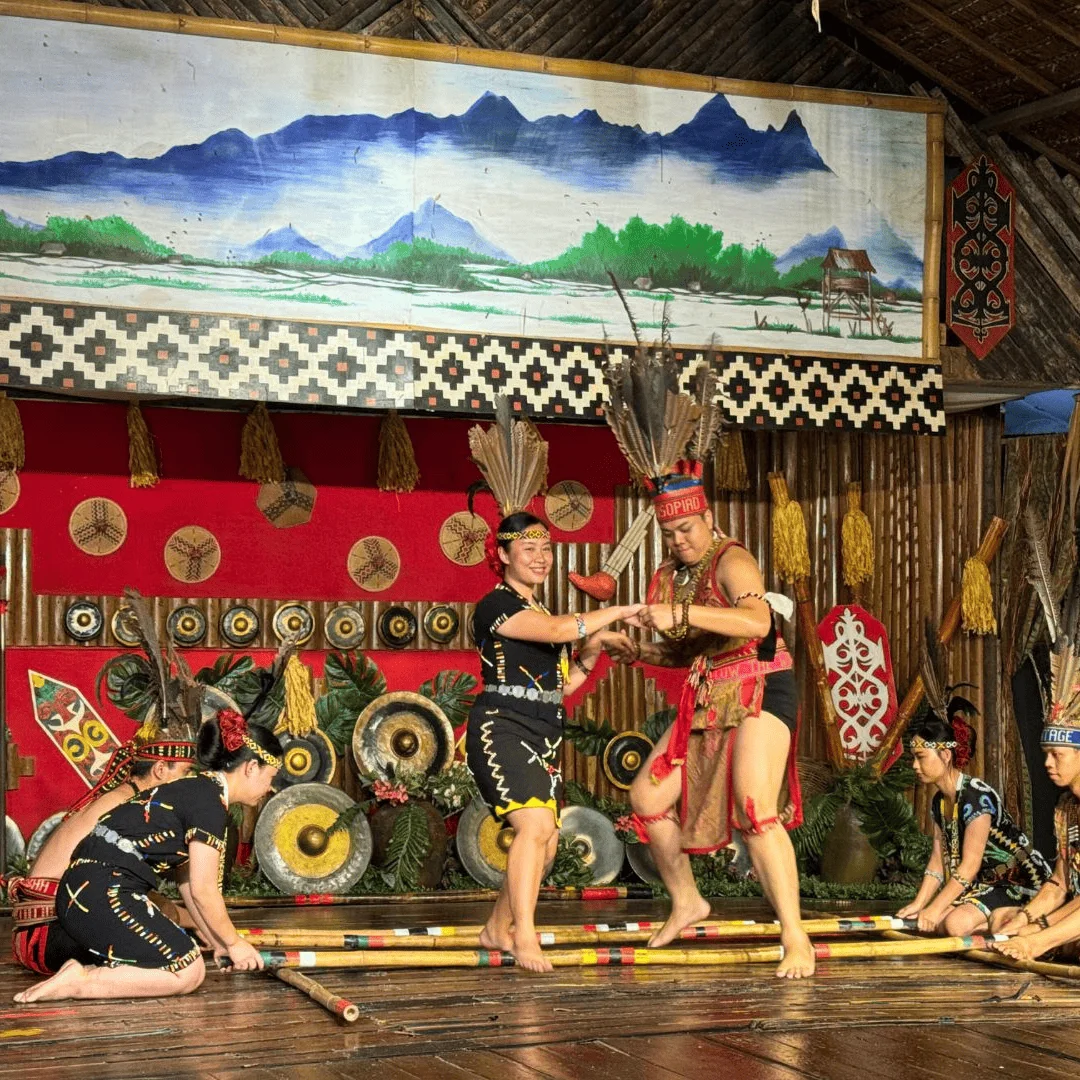
This is not a recreated tourist village. It was built by the family, on family land, to keep their history alive.
Getting there: Located in Kampung Kuai Kadazon, Penampang District. Approximately 30 minutes by car from Kota Kinabalu city centre. Private car hire or a guided tour from KK is the most practical option.
Travellers can combine Monsopiad Heritage Village with Kota Kinabalu city sightseeing tour for a fuller introduction to Sabah’s cultural heritage.
Bukit Tengkorak (Skull Hill), Semporna
Most visitors who pass through Semporna head straight to the dive boats for Sipadan. Almost non-stop at Bukit Tengkorak, which is quietly one of the most significant prehistoric sites in all of Southeast Asia.
Bukit Tengkorak, meaning Skull Hill, sits about 10 kilometres south of Semporna town. The site occupies a volcanic rock shelter that forms part of an ancient volcanic crater, rising around 600 feet above sea level. Archaeological research carried out between 1994 and 1995 by Universiti Sains Malaysia in collaboration with Sabah Museum revealed something remarkable: this site was the largest prehistoric pottery production centre in Southeast Asia during the Neolithic period, approximately 3,000 years ago.
Thousands of decorated pottery shards were discovered in layers of volcanic ash, alongside stone tools, animal remains, and evidence of human burials. The clay used to make the pottery was sourced locally, and the volcanic rock formations created natural kilns for firing.
What makes Bukit Tengkorak particularly compelling is what the artifacts suggest about trade and movement. Evidence points to maritime contact and long-distance exchange between the people of Bukit Tengkorak and communities along the southeastern coast of Sabah, the Sulu Archipelago, Palawan, southern Mindanao, Sulawesi, and island chains stretching toward Melanesia and the Pacific. This was not an isolated settlement.
The climb to the summit involves 610 wooden steps. At the top, there are panoramic views of Semporna and its surrounding islands. There is also a small archaeological gallery at the entrance displaying excavated artefacts.
Entry is free. Registration is required before entering the site.
Getting there: Located along the Semporna-Tawau road, approximately 10km from Semporna town. Accessible by taxi or as part of a Semporna day trip.
Patau-Patau Water Village, Labuan
Labuan sits just off the coast of Sabah, and Patau-Patau is one of its quieter, lesser-visited corners.
This traditional water village, built on stilts above the sea, represents a way of life that has defined coastal communities in this part of Borneo for generations. The Bajau and other sea-dwelling communities of Sabah and the surrounding waters have historically built their homes over water rather than on land, maintaining a maritime existence tied closely to fishing and inter-island trade.
Patau-Patau Sabah is not a recreated heritage site. It is a functioning community, which makes a visit feel more honest than a formal museum experience. The atmosphere is peaceful, the architecture distinctive, and the setting quietly photogenic.
For visitors passing through Labuan, it makes a thoughtful stop before or after heading to the airport.
The Sandakan Heritage Trail
While the Agnes Keith House and Sandakan Memorial Park are individual stops, they sit within a broader circuit worth knowing about.
The Sandakan Heritage Trail connects many of the town’s historically significant locations on foot. The trail passes through the Agnes Keith House, St. Michael’s and All Angels Church (one of the oldest churches in Sabah), the Sandakan Waterfront, and several colonial-era buildings that speak to the town’s early role as the capital of British North Borneo.
Sandakan was the colonial capital before Kota Kinabalu and bears its history in a way that KK, having been largely rebuilt, does not. Walking the trail takes between two and three hours, and most of the key stops are within reach of each other on a single morning.
Guided tours of the Sandakan Heritage Trail are available and worth taking if this kind of layered historical context is what you’re looking for.
Planning Your Sabah History Trip in 2026
The historic sites in Sabah are spread across the state. Agnes Keith House, Sandakan Memorial Park, and the Sandakan Heritage Trail cluster in the east around Sandakan. Monsopiad Heritage Village is a short drive from Kota Kinabalu in Penampang. Bukit Tengkorak is in the south near Semporna. Patau-Patau is on Labuan Island.
Most visitors base themselves in Kota Kinabalu and take day trips or overnight journeys to reach sites further east. Sandakan is roughly two hours by road from KK or accessible by a short domestic flight.
A practical approach for history-focused travellers:
Spend a day in and around the best places in Kota Kinabalu, covering Monsopiad Heritage Village, then take an overnight or multi-day trip east to Sandakan to cover the Agnes Keith House, Memorial Park, and Heritage Trail. If continuing south toward Semporna for diving, factor in a half-day stop at Bukit Tengkorak.
Explore Sabah’s Heritage with a Local Guide
Understanding these sites takes more than reading the information boards. A knowledgeable local guide changes the experience entirely, adding context, storytelling, and access that you won’t find from self-guided visits alone.
City MPV Travel and Tours, based in Kota Kinabalu, offers guided Kota Kinabalu tours that take in key cultural and heritage landmarks around the capital. Their guides are fluent in English, Mandarin, and Malay, and the tours are designed for travellers who want genuine insight into Sabah’s history and culture, not just a loop of photo stops.
For those arriving in Kota Kinabalu and wanting to combine heritage with Sabah’s natural highlights, City MPV’s range of Sabah tour packages covers everything from cultural village visits to river wildlife cruises and island day trips.
It’s a practical starting point for anyone planning a trip to Sabah who wants to cover more ground with less hassle.