

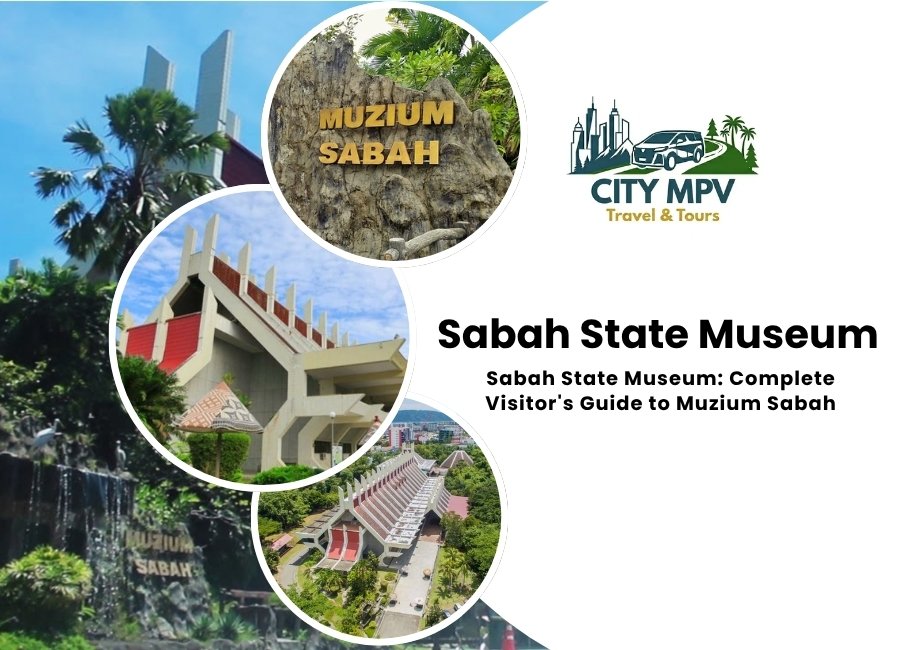
If you want to understand Sabah in a single afternoon, the Sabah State Museum is where you start. Not because it tries to compress everything into neat little panels, but because it genuinely holds the layers of Borneo’s story, the archaeology, the wildlife, the trade routes, the colonial footprint, the living cultures of more than 30 indigenous groups, all in one sprawling, thoughtfully arranged complex just minutes from Kota Kinabalu city centre.
This guide covers everything you need before, during, and after travelling to Kota Kinabalu: what to see, how long to spend, what the admission costs, things to do in Sabah, and which parts are worth your time versus which you can skip if you’re short on hours.
What Is the Sabah State Museum?
The Sabah State Museum, known locally as Muzium Sabah, is the official state museum of Sabah, Malaysia. It sits on 17 hectares at Bukit Istana Lama, the very hill where the British North Borneo Governor’s Istana once stood, and has been at this location since 1984. The museum was first established in 1965 as a modest collection in a Gaya Street shophouse. When it outgrew that space, the state government donated the current land, and the complex that visitors walk through today was built and officially opened in 1984–1985.
What makes Muzium Sabah different from most regional museums is its scope. It is not a single building with a single focus. The complex includes the Main Building, the Heritage Village, the Ethnobotanical Garden, the Science and Technology Centre, the Sabah Art Gallery, and the Sabah Islamic Civilization Museum. Each functions as its own destination, and together they form one of the most comprehensive museum experiences in all of Malaysia.
Getting There: Location and How to Reach It
The museum is at Jalan Muzium (also referenced as Jalan Bukit Istana Lama), 88300 Kota Kinabalu, Sabah, Malaysia. It sits roughly 4 km from the Kota Kinabalu city centre, which translates to about a 10 to 15-minute drive.
Getting there by taxi or Grab is the most straightforward option and costs very little from the city centre. If you prefer public transport, buses heading toward the museum area run from the Wawasan Plaza terminal, though routes can be infrequent, so confirming schedules locally before your visit is a good idea. Visitors driving themselves will find parking available on site.
The museum sits on a hill, which means the grounds involve some uphill walking and uneven terrain, particularly in the Heritage Village. Comfortable, closed-toe shoes make a real difference here.
Opening Hours and Admission Fees
The Sabah State Museum is open daily from 9:00 AM to 5:00 PM. This consistent seven-day schedule is convenient for travellers who may only have a narrow window on a specific day.
For admission, the fees are:
Malaysian citizens: RM 2.00
Foreign visitors: RM 15.00
Free entry applies to students in uniform, senior citizens, persons with disabilities, and taxi drivers.
The same ticket grants access to both the Main Building and the Islamic Civilization Museum, making the RM 15 foreign visitor fee genuinely good value given the breadth of what the complex covers.
The Main Building: What’s Inside
The architecture of the main building immediately signals what kind of place this is. The four-storey structure was designed to resemble a traditional Rungus longhouse, one of Sabah’s indigenous building forms. The pitched roof and the elevated form set the tone before you step through the door.
Inside, the galleries are organized thematically across the floors.
Natural History Gallery
The ground floor is devoted to Sabah’s natural world. The biodiversity on display reflects the full ecological range of the state, from coastal mangroves through dense rainforest to the highland meadows that ring Mount Kinabalu. Mounted specimens and displays cover Sabah’s endemic birds, hornbills, the Kinabalu serpent eagle, and other species found nowhere else in the world. The marine section highlights the coral reef systems and sea life that make Sabah’s waters a global diving destination. The floor also addresses Sabah’s geological identity: its position on the edge of the Pacific Ring of Fire, its volcanic history, and the tectonic forces that shaped Borneo.
The centrepiece many visitors photograph first is the blue whale skeleton hanging in the main hall, Malaysia’s largest, and a striking introduction to the scale of what lives off Sabah’s shores.
Ethnography Gallery
This is the floor that holds the most cultural weight. Sabah is home to over 30 indigenous ethnic groups, among them the Kadazan-Dusun, the Bajau, the Murut, the Rungus, and the Suluk, and this gallery is the fullest single-room account of their traditions, material culture, and daily life that exists anywhere. Costumes, ritual objects, musical instruments, weaving, beadwork, and ceremonial pieces are displayed alongside detailed contextual information about each community.
A soundproofed section within the gallery holds a dedicated collection of traditional musical instruments, which rewards visitors who take the time to read about the cultural context of each piece.
Ceramics Gallery
Sabah’s ceramic collection tells a different kind of story, one about trade. For centuries, Sabah sat at the crossroads of maritime Southeast Asian commerce, and Chinese, Thai, and other regional traders passed through in significant volume. The ceramics on display, including large storage jars, spittoons, cosmetic containers, and ceramic pillows, represent the physical residue of those centuries of exchange. Some of these pieces carry enormous cultural value even today; Bornean ceramic jars were historically used as currency, as dowry payment, and as ritual objects of great prestige.
Archaeology and History Gallery
This floor traces Sabah’s human story from prehistoric times through the formation of Malaysia in 1963. It covers early settlement, the shifting political arrangements of the pre-colonial period, the arrival of the British North Borneo Chartered Company, the Japanese occupation during World War II, and Sabah’s path to independence. Artifacts, documents, maps, and photographs anchor each period, giving the gallery the feel of a proper historical archive rather than a simplified timeline.
Headhunting Gallery
This is the room visitors approach with curiosity and leave with a more complicated understanding. The gallery documents the practice of headhunting as it existed among certain Bornean communities, displaying actual human skulls, blowpipes, and the containers used to store blowpipe poison. It handles the subject with ethnographic seriousness rather than sensationalism, explaining the ritual, social, and symbolic meanings that headhunting carried within the communities that practiced it.
The Heritage Village
Just outside the main building, the Heritage Village is where the museum stops being about display cases and becomes something you walk through and step inside. The village is an open-air collection of full-scale traditional houses representing Sabah’s major ethnic groups, constructed to original specifications using traditional materials and methods.
The Murut longhouse is one of the most remarkable structures here. It is large, communal in design, and contains a traditional trampoline, a woven bamboo floor section used historically in celebration, that schoolchildren and some adult visitors occasionally try. The Bajau stilted houses reflect the water-dwelling traditions of the sea nomads who have inhabited Sabah’s coastline for generations. Rungus longhouse structures show a different configuration entirely, reflecting that community’s relationship to the land rather than the sea.
Visitors are generally welcome to remove their shoes and enter the houses, which are open rather than cordoned off. Informational placards at each structure explain construction methods, cultural significance, and the daily routines of residents. The Heritage tour to this village is best if visited before 11:00 AM, when temperatures are cooler. The afternoon sun across open grounds is intense, particularly between the two phases of the village, which are a short walk apart through what briefly feels like secondary rainforest.
Ethnobotanical Garden
The Heritage Village sits within the larger Ethnobotanical Garden, which is itself worth attention. The garden is a systematic planting of indigenous flora organized by use: medicinal plants, food plants, commercially significant species, and ornamentally grown varieties. Each plant is labeled and described in terms of its traditional application, how it was prepared, which communities used it, and for what purpose.
For anyone interested in ethnobotany, traditional medicine, or simply the intersection of plant knowledge and culture, this section offers material that is not easily found elsewhere. It also makes for a pleasant walk even if you are not reading every sign.
Science and Technology Centre
The Science and Technology Centre rounds out the complex with three main exhibition areas. The most popular among travellers is the North Borneo Railway exhibit, which places vintage carriages and railway infrastructure from the late nineteenth century in context. Sabah’s narrow-gauge railway was constructed starting in the 1890s primarily to transport agricultural commodities to the coast. The carriages on display represent an era when the railway was the economic artery of British North Borneo.
The other two exhibitions cover oil and gas production in Sabah and the history of broadcasting in the state, both of which provide context for Sabah’s modern economic identity that the historical galleries do not address.
Sabah Islamic Civilization Museum
Included in the same admission ticket, the Islamic Civilization Museum is a separate building within the complex that is worth the 15-minute detour it takes to reach. Its Islamic World Gallery holds artifacts that document how Islam arrived in Sabah and spread through the region, including an 18th-century Persian Quran stand, old Qurans, Indonesian wooden caskets with Quranic engravings, brassware, calligraphy, and miniature mosque models.
For visitors unfamiliar with the role of Islam in shaping coastal Borneo, this museum fills in a genuinely important part of the picture. The collection is well-maintained, most exhibits carry English translations, and the space is quiet and uncrowded.
Sabah Art Gallery
The Sabah Art Gallery, also part of the complex, hosts rotating exhibitions of work by local and regional artists. The permanent and temporary collections together present a window into contemporary Sabah artistic expression alongside more traditional visual forms. It is worth a walk-through if the current exhibition aligns with your interests, and it takes no more than 20 to 30 minutes.
How Long Should You Spend?
Two to three hours covers the main building galleries, the Heritage Village, and a walk through the Ethnobotanical Garden at a reasonable pace without rushing. If you add the Islamic Civilization Museum and the Science and Technology Centre and take your time reading exhibits, three to four hours is more realistic. Visitors with a deep interest in ethnography, natural history, or archaeology easily fill half a day.
Arriving at or shortly after the 9:00 AM opening works best for two reasons: the outdoor Heritage Village is cooler, and the main building galleries are quieter before tour groups arrive mid-morning.
What to Bring
Comfortable walking shoes matter more here than at most museums, given the outdoor components and uneven ground in the Heritage Village. Light, breathable clothing suits Sabah’s year-round heat. A reusable water bottle is sensible; the museum grounds are large and the nearest cafes are outside the complex. A camera or phone for photography is welcome in most sections of the museum, though some special exhibits restrict flash.
Nearby Attractions
The museum’s location on Jalan Muzium places it close to several other Kota Kinabalu landmarks. The Sabah State Mosque is one of the most photographed buildings in the city and is only a short drive away. Signal Hill Observatory offers views over the city and the islands of Tunku Abdul Rahman Marine Park. For visitors building a full day, combining the museum with the Agnes Keith House in Sandakan is possible on a longer itinerary, and notably, the RM 15 admission ticket for the museum complex is reportedly also valid at Agnes Keith House on the same day.
Plan Your Visit Without the Logistics Headache
Getting to the Sabah State Museum is easy once you have reliable transport sorted, and that is where most first-time visitors in Kota Kinabalu run into friction. The museum sits 4 km from the city centre, the Heritage Village involves a fair amount of ground-covering on foot, and if you are combining the museum with other KK attractions in a single day, hopping between taxis adds up in both time and cost.
City MPV Travel and Tours takes that friction away. It is a private MPV transfer service built specifically for Sabah travellers who want to move between attractions, airports, and hotels on their own schedule rather than around public bus timetables or surge-priced rides. Book a vehicle for a half-day or full-day, tell your driver your itinerary, Sabah State Museum, the State Mosque, Signal Hill, wherever the day takes you, and the logistics handle themselves. Your time in Sabah is better spent inside the Heritage Village than standing outside it waiting for a ride.
👉 Book your Kota Kinabalu transfer with City MPV Travel & Tours